
You can’t buy or force a ChatGPT recommendation, but you can make your business easy to find and easy to trust. Get listed and reviewed where AI tools look, keep your business details identical everywhere, put direct answers on your pages, let AI search crawlers in, and run the same test prompts every month.
That’s the short version. Here’s how to get ChatGPT to recommend your business, on any website platform.
Try this first. Open ChatGPT, Perplexity or Google and ask: “Who’s the best [your service] in [your city]?” If a competitor gets named and you don’t, this post is for you. If nobody gets named, that’s an opening.
How do AI search tools decide which businesses to mention?
Each AI search tool reads pages from the web, writes an answer and usually cites a few sources. Three things decide whether you’re in it. Knowing them is the first step in how to get your brand mentioned in ChatGPT.
1. They have to be able to read your site.
- Google AI Overviews and AI Mode use Google’s normal index. Google says “there are no additional requirements to appear in AI Overviews or AI Mode, nor other special optimizations necessary.” A page just has to be indexed and eligible to show with a snippet. (Google Search Central)
- ChatGPT search uses OpenAI’s crawler, OAI-SearchBot. OpenAI says sites that opt out of it “will not be shown in ChatGPT search answers.” (OpenAI) It also “sometimes partners with other search providers,” and its help center lists Microsoft and Shopify. (OpenAI Help Center)
- Perplexity uses PerplexityBot and recommends allowing it in robots.txt “to ensure your site appears in search results.” (Perplexity)
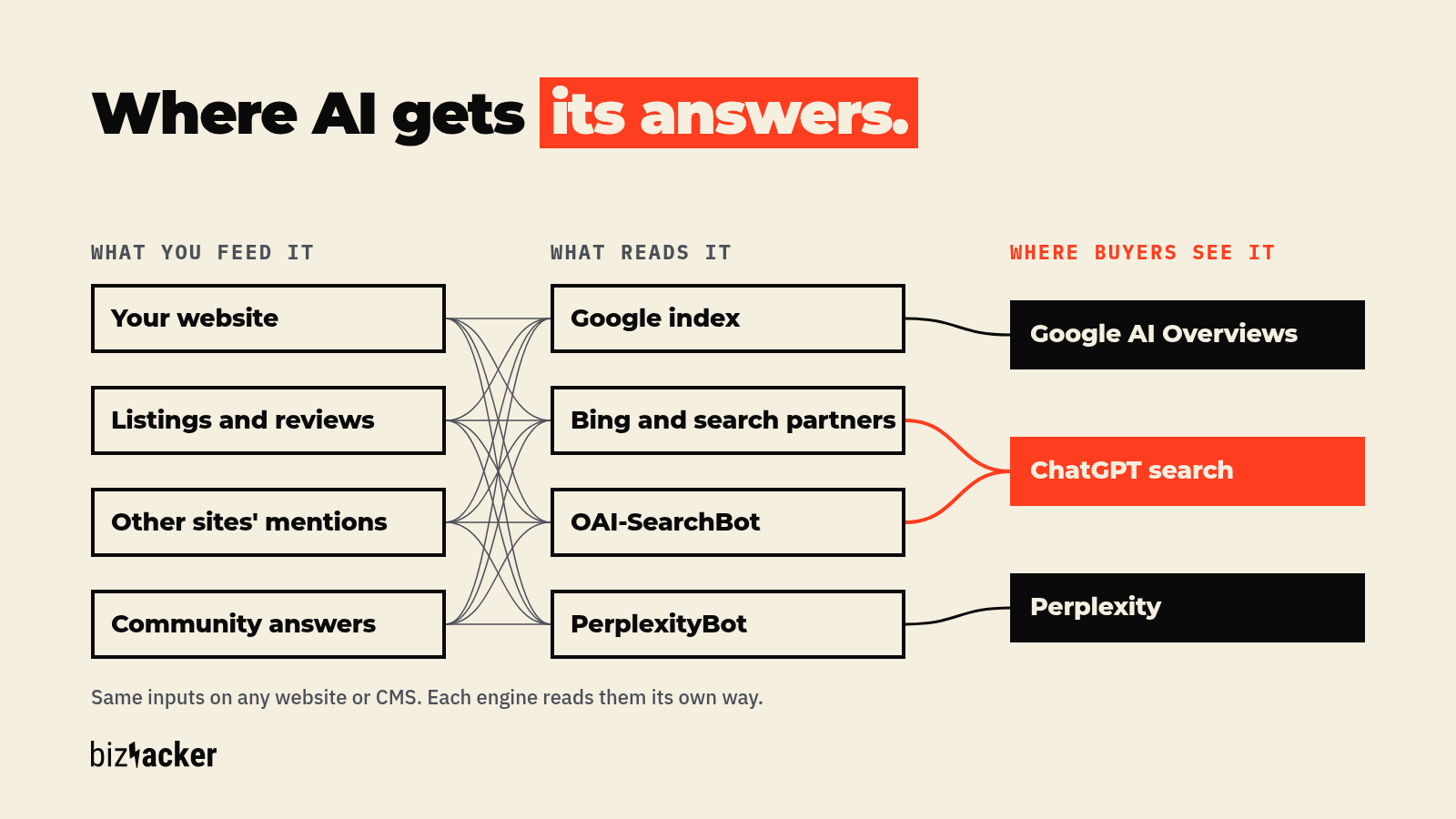
2. Other people have to talk about you. Ahrefs studied 75,000 brands and found that branded web mentions correlated strongly with how often a brand shows up in AI answers (0.66 to 0.71 across ChatGPT, AI Mode and AI Overviews). Mentions on YouTube correlated most strongly of anything they measured (about 0.737). Ahrefs sells the tool that tracks this, so read it as vendor data, and as they say themselves: correlation isn’t causation. (Ahrefs, Dec 2025)
3. Your page has to answer the question. AI answers are short and built from a few sources. In Pew Research Center’s study of real Google browsing, 88% of AI summaries cited three or more sources. (Pew Research Center, July 2025)
Why care? Because fewer people click past the answer. Pew found that people who saw an AI summary clicked a regular search result on 8% of visits, against 15% when there was no summary. They clicked a link inside the summary itself on just 1% of visits. (Pew Research Center, July 2025)
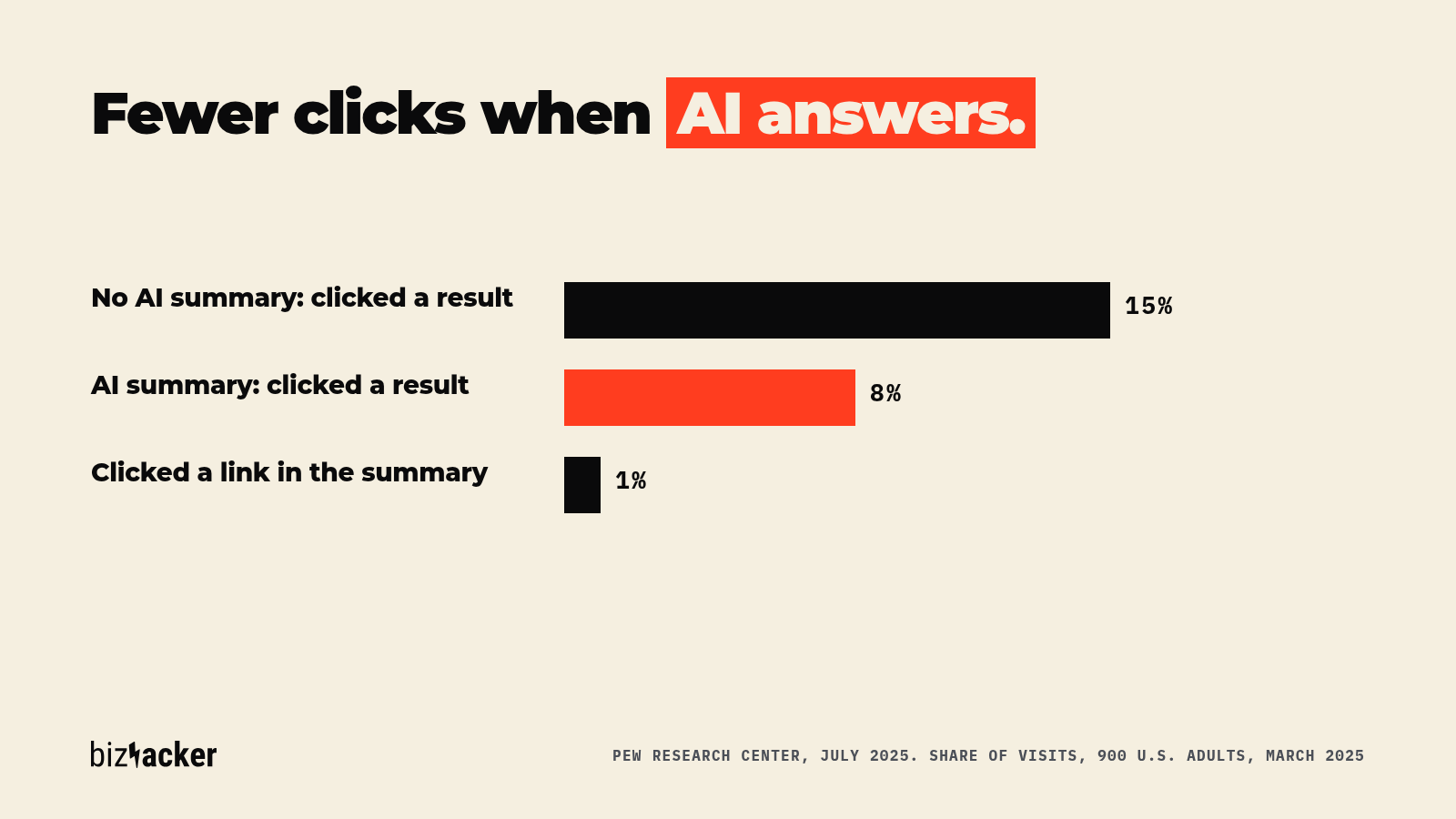
If the answer is where the decision happens, you want to be in the answer.
How do I get ChatGPT to recommend my business?
Nine steps to get mentioned in ChatGPT, Perplexity and Google’s AI answers. None of them need a particular CMS. They work the same on WordPress, Squarespace, Wix, Webflow, Shopify, HubSpot or a hand-coded site. Most take an afternoon. A few take months.
01. Be in the places AI pulls from
AI tools lean on sources that already describe local and small businesses: Google Business Profile, Bing Places, review sites, and the directories your industry actually uses (a trade association, a chamber of commerce, the top two or three directories for your field). Claim them, fill every field, add real photos of your work, and keep hours current.
Then ask for reviews. Ask every customer the same way, after the job, with a direct link. Don’t pay or offer anything for reviews, don’t ask only the happy customers, and never write reviews yourself or have staff or family post them without clearly saying how they’re connected to the business. The FTC’s Consumer Review Rule bans fake reviews, reviews bought for a particular sentiment and undisclosed insider reviews (16 CFR Part 465), and Google’s own policy bans incentives and “selectively” asking for positive reviews (Google Maps content policy). This is not legal advice.
02. Earn mentions you don’t control
This is the slow one, and the one the Ahrefs data points at. Get named on other people’s pages: a local news story, a partner’s page, a podcast, a YouTube guest spot, an industry roundup.
Communities count too. If people ask questions in a Reddit community, a Facebook group or an industry forum that you can honestly answer, answer them. Say that you own the business (and anyone posting for you, like staff or an agency, should say who they work for), follow each community’s rules, and don’t post to sell. Reddit’s content policy asks people to “participate authentically” and not spam or manipulate content. (Reddit)
03. Keep your business details identical everywhere
AI tools have to be sure that the “Acme Plumbing” on your site, your Google profile and a review site are the same business. Use the exact same name, address or service area, phone number, hours and list of services everywhere. Google tells businesses to represent themselves “as it’s consistently represented and recognized in the real world.” (Google Business Profile guidelines)
On your site, add Organization or LocalBusiness structured data with your name, logo, phone, address and “sameAs” links to your real profiles. Every major platform supports this through a setting, an app or a custom code block.
04. Write answer-first pages
For each service, write a page that answers the questions a buyer would ask an AI tool: what it is, who it’s for, where you serve, how long it takes, and how pricing works. Put a plain 40 to 60 word answer at the top, then the detail. Use question-style headings.
Keep the important words in real page text, not only in images, sliders or scripts. Google lists “making sure that important content is available in textual form” as a best practice for its AI features. (Google Search Central)
05. Add FAQ schema, and keep it honest
FAQ schema (FAQPage JSON-LD) labels your questions and answers so machines can read them cleanly. Be realistic about it: Google says there’s “no special schema.org structured data that you need to add” for its AI features (Google Search Central), and Google stopped showing FAQ rich results in Search in May 2026 (Google Search Central updates). So treat it as cheap housekeeping for other engines and tools, not a lever. If you add it, the schema must match the visible text on the page word for word. Google says to make sure “your structured data matches the visible text on the page.”
06. Get into Bing, and turn on IndexNow
ChatGPT search sometimes uses outside search providers, and OpenAI names Microsoft among them, so make sure Bing knows your site. Verify it in Bing Webmaster Tools, submit your sitemap, and turn on IndexNow, which tells Bing and other participating engines the moment a page is added or changed. Several platforms and CDNs have IndexNow built in, so check your settings before you install anything.
07. Let the AI search crawlers in
Open yoursite.com/robots.txt. Make sure it doesn’t block the bots that power AI search:
User-agent: OAI-SearchBot
Allow: /

User-agent: PerplexityBot
Allow: /

User-agent: Googlebot
Allow: /

User-agent: Bingbot
Allow: /
Search bots and training bots are separate choices. OpenAI says each setting “is independent of the others,” so you can allow OAI-SearchBot for search and still block GPTBot from training. (OpenAI) Then check your host, firewall or CDN. OpenAI says a site is only eligible if the host or CDN “allows traffic from OpenAI’s published searchbot IP addresses.” (OpenAI Help Center)
08. Publish something only you have
Give AI something nobody else has: your real process, a plain pricing guide, a checklist from your own jobs, or numbers from your own work. Only publish real data. A made-up stat gets repeated with your name on it.
09. Check it every month
Run the same self-check below on the first Monday of every month and write down what changed. That’s the only way to know if any of the above is working, and whether your brand mentions in AI search are moving.
Is llms.txt worth it?
Not much, based on the evidence so far. llms.txt is a text file at your site’s root that lists your best pages for AI tools. It’s cheap to add and it won’t hurt, but don’t expect it to get you mentioned.
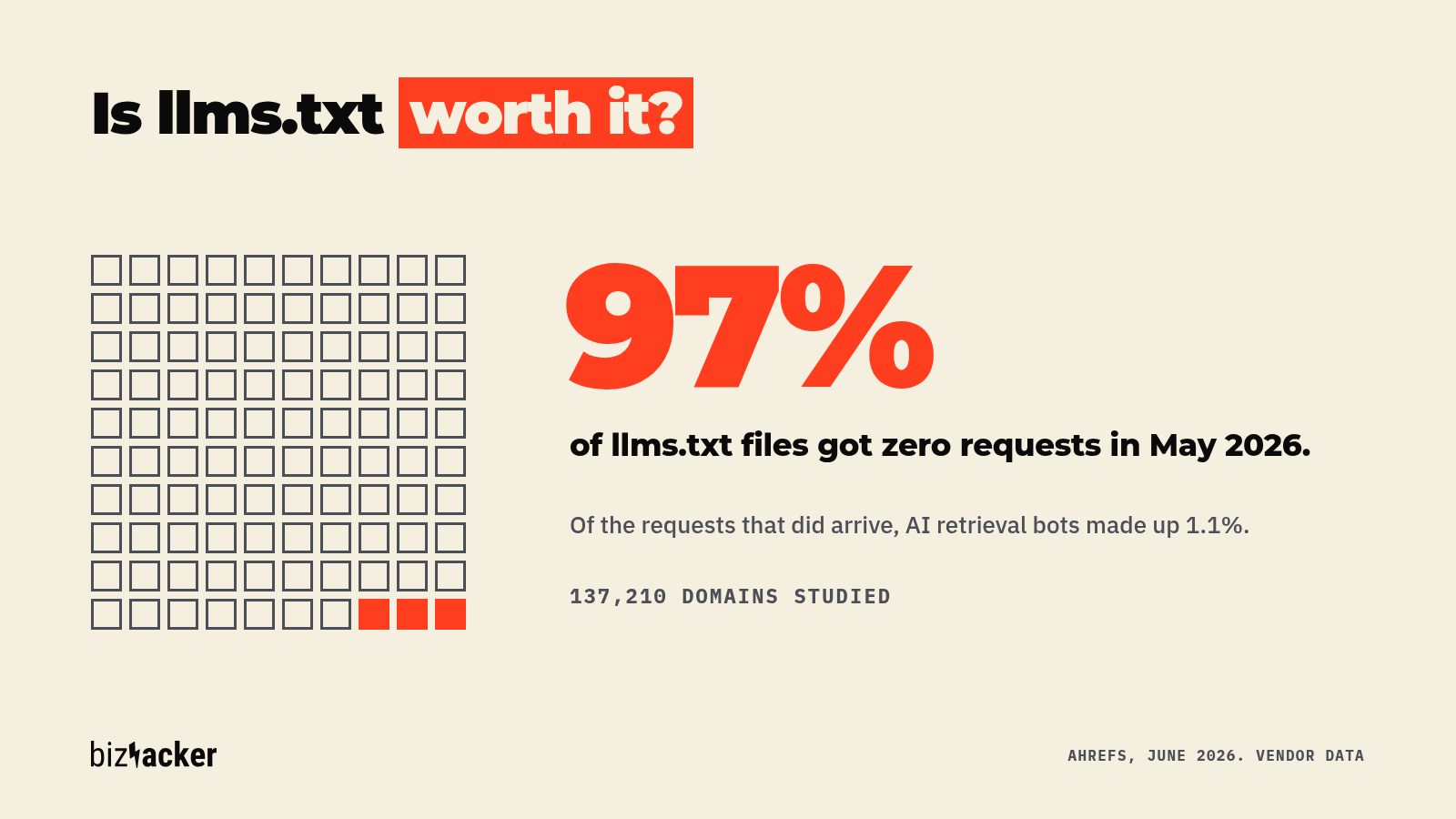
Ahrefs checked 137,210 domains in May 2026. 28% had an llms.txt file, and 97% of those files got zero requests that month. Of the requests that did happen, AI retrieval bots (the ones that fetch pages to answer live questions, like OAI-SearchBot and PerplexityBot) made up 1.1%. Ahrefs sells SEO tools, so read it as vendor data. (Ahrefs, June 2026)
Google agrees: “You don’t need to create new machine readable files, AI text files, or markup to appear in these features.” (Google Search Central)
We used to recommend llms.txt in our LLM rankings guide. The evidence has moved since, and we’re updating that post. Spend the time on steps 1 to 3 instead.
How do I check if AI mentions my brand?
Run this free AI visibility self-check. It takes about 15 minutes and needs nothing but a browser. It’s how to check AI visibility without buying a tool.
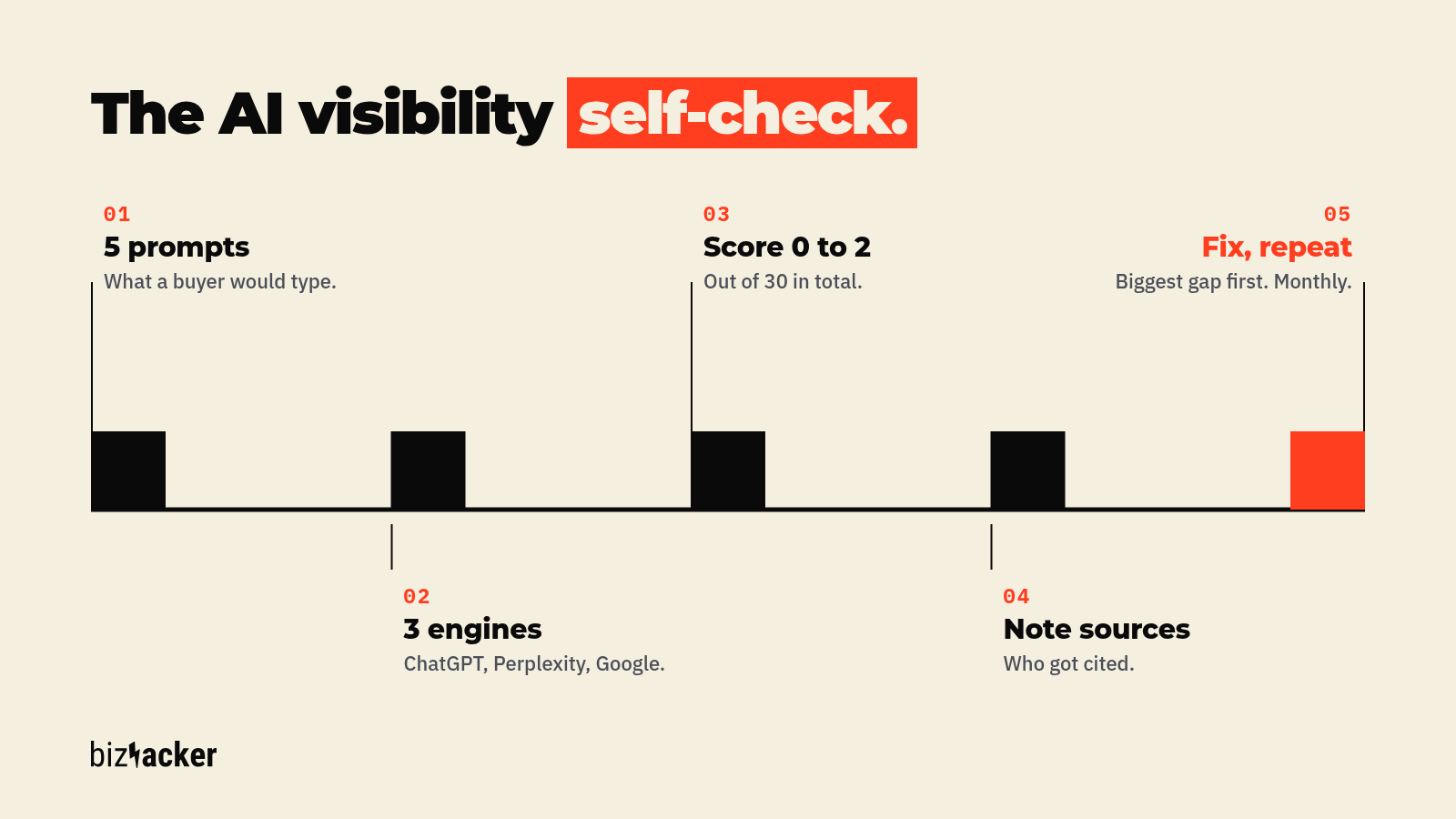
Step 1: Write 5 prompts a real customer would type.
- “Who’s the best [your service] in [your city]?”
- “What’s a good [your service] for [a specific need]?”
- “[Your business name] reviews”
- “[Your business name] vs [main competitor]”
- “What does [your business name] do?”
Step 2: Run each one in 3 engines. ChatGPT with search on, Perplexity, and Google (look at the AI Overview or AI Mode). Use a private or logged-out window so your history doesn’t skew the answer.
Step 3: Score every answer.
- 2: you’re named and the details are right.
- 1: you’re named but something’s wrong (old hours, wrong service, wrong city), or you’re only in the source list.
- 0: you’re not there.
5 prompts times 3 engines times 2 points gives you a score out of 30.
AI visibility scorecard (score each cell 0, 1 or 2)
| # | Prompt | ChatGPT | Perplexity | |
|---|---|---|---|---|
| 1 | Who's the best [your service] in [your city]? | |||
| 2 | What's a good [your service] for [a specific need]? | |||
| 3 | [Your business name] reviews | |||
| 4 | [Your business name] vs [main competitor] | |||
| 5 | What does [your business name] do? | |||
| Total: ____ / 30 | ||||
Step 4: Write down the sources. For every answer, note which sites the engine cited. That list is your to-do list. If an engine keeps citing a directory you’re not on, get on it. If it cites a competitor’s page that answers the question better than yours, write a better answer.
Step 5: Repeat monthly. AI answers change from run to run, so compare month to month, not day to day. Track three numbers: your score out of 30, how many prompts name you, and how many cited sources you control or appear on.
A low first score isn’t bad news. It’s a baseline.
What doesn’t work
- Buying reviews, or paying for mentions that aren’t disclosed as paid. It breaks platform rules, and in the U.S. it can break FTC rules.
- Hiding text for AI. White text, hidden instructions to AI tools, pages stuffed with your brand name.
- Spamming communities. Moderators remove it.
- Anyone who guarantees a mention. Nobody can. OpenAI says it plainly: “Placement is not guaranteed.” (OpenAI Help Center)
What happens after AI sends you a lead?
Getting recommended only matters if someone answers when that buyer fills out your form. If your reply takes two days, the next business on the list gets the job.
That’s speed to lead, and it’s free to fix. Want to know where you stand? For $10, our speed to lead test has bots fill out your contact form like a real customer and time the first human email reply, then sends you a graded scorecard.
Why this matters to me
For the last three years, my team at OneIMS, a marketing agency I’m part of, has been refining a system for exactly this: the MAPS Framework. MAPS stands for Model buyer intent, Answer clearly, Prove and place, and Structure and stay fresh. If those sound familiar, they should. They’re the ideas behind the steps above.
It isn’t built for one kind of business. The framework can be used in any industry. The point of all of this is simple: don’t get left behind in the AI search era. Start with the self-check, fix one gap, and keep going.
Steal this
- The 5-prompt AI visibility self-check and its 30-point score.
- The robots.txt lines above.
- The 9 steps, in order. Start with 1 to 3.
Want the next one before everyone else?
Reply with your self-check score. I read every reply.
FAQ
How do I get ChatGPT to recommend my business?
You can’t force it, but you can make it more likely. Get listed and reviewed on the sites AI tools cite, earn mentions on other sites, keep your business details identical everywhere, write answer-first pages, allow OAI-SearchBot in robots.txt, and check the same prompts every month.
How long does it take to show up in AI search?
There’s no fixed timeline. OpenAI says robots.txt changes take about 24 hours to reach ChatGPT search, but mentions depend on what other sites say about you, and that builds over months. Run the self-check monthly to see progress.
Is llms.txt worth it?
Not much. It’s cheap and harmless, but Ahrefs found that 97% of llms.txt files got zero requests in May 2026, and Google says you don’t need AI text files to appear in its AI features. Spend the time on listings, reviews and clear pages.
How do I check if AI mentions my brand?
Write 5 prompts a customer would type, run each in ChatGPT, Perplexity and Google in a private window, and score each answer 0, 1 or 2. Note which sources get cited. Repeat monthly and compare your score out of 30.
Does FAQ schema help with AI search?
A little, at best. Google says no special schema is needed for its AI features, and it stopped showing FAQ rich results in May 2026. It’s still a clean way to label questions and answers for other tools, as long as it matches the visible text.
Should I block AI crawlers?
Don’t block the search ones if you want to be mentioned. Allow OAI-SearchBot, PerplexityBot, Googlebot and Bingbot. Training bots like GPTBot are a separate choice, and OpenAI lets you block training while still allowing search.



 Amanda Russell


